
Social
Divorce refers to the legal separation of parents, resulting in them living apart. This situation impacts numerous families across Australia and significantly influences children’s lives.
Children often face the challenge of adapting to two separate households, which can lead to confusion, stress, and various adjustments.
Awareness of divorce is crucial since a child’s family dynamics play a vital role in shaping their emotions, behaviours, and educational experiences. Theoretical frameworks such as Bronfenbrenner’s ecological systems theory illustrate how a child’s familial context directly affects their developmental process. When divorce occurs, it alters this environment and subsequently impacts children’s relationships with adults, their ability to form friendships, and their engagement in learning activities (Grace & Baird, 2022).
The nature of divorce in Australia is both varied and changing. Families may adopt different arrangements such as shared custody or designate one parent as the primary caregiver. Studies indicate that many families implement flexible parenting plans that adjust according to the evolving needs of children (Australian Institute of Family Studies, 2019). These adaptations reflect cultural transformations, and the diverse range of family structures present today.
Impact on Children and Families:
Divorce can harm children’s emotional wellbeing, sometimes leading to sadness, anxiety, or confusion. Little children may not understand why their family changed and can communicate emotions with actions rather than words. All those emotions may be affecting how they focus, how they do their learning, and build positive relationships in early childhood services.
For families, divorce can bring financial alterations and restructured daily routines, which may increase stress. Early childhood educators are especially aware of these issues and need to be sensitive when they are providing support to children, supporting them to feel safe, valued, and understood during this transition (Grace & Baird, 2022).
Social Policy and Australian Responses:
Some children and families in Australia are provided with services to help with separation. The Family Law Act invites parents to act in a child’s best interests and supports shared parenting arrangements were safe and practical. Services for dealing with changes may be provided through government programs like mediation, parenting education, and counselling (Australian Institute of Family Studies, 2019).
Data show that many children experience parental separation by the age of 12. Providers such as Family Relationship Centres offer practical support to help reduce conflict and support children’s wellbeing. These policies have an impact on early childhood services which provide inclusive, stable environments and positively work with families.
Strategies for Practice:
Build a Safe Environment: Early childhood educators should establish trusting relationships with children by creating a space that is calm, predictable, and secure. When the young person is experiencing changes at home, he or she must have consistency through their daily routines at the childcare setting or preschool to feel safe and supported during uncertain times (Grace & Baird, 2022).
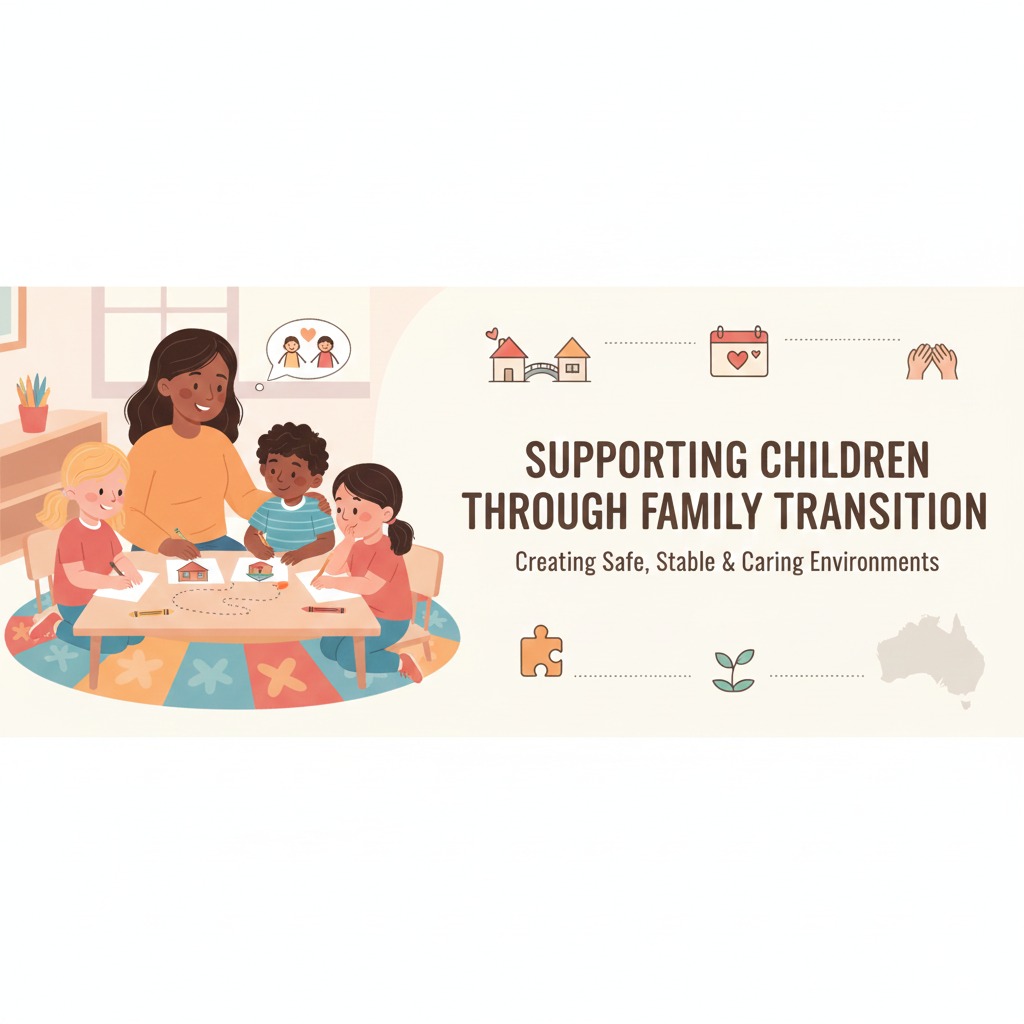
Encourage Emotional Expression: Children commonly struggle to communicate complicated moods, such as sadness, confusion, or anger, when their parents separate. Through various activities, including storytelling, drawing, role-playing, or circle time discussions, educators can enable children to identify and share their feelings in a safe and supportive environment. This approach promotes emotional literacy and resilience (Grace & Baird, 2022).
Maintain Consistent Routines: Consistency through regular routines gives children a sense of security even if family life is changing. Knowing what to expect at preschool or childcare lessens anxiety and promotes self-regulation in children engaged in learning activities (Grace & Baird, 2022).
Communicate with Families: Collaborative communication with parents is key to understanding a child’s specific needs and experiences. Respectful and clear communication builds partnerships with families and educators they need to know what the home situations are, as well as how they can help and what support would work as a support (Australian Institute of Family Studies, 2019).
Promote Social Skills and Peer Relationships: Divorce is one way to shake a child’s self-esteem. Educators are essential in fostering cooperative play, teamwork, and positive friendships, all of which underpin children’s social wellbeing and sense of belonging (Grace & Baird, 2022).
Community and Professional Partnerships:
Family Relationship Centres: Providing services including mediation and counselling to assist parents in conflict settlement and prepare parenting strategies that emphasise children’s wellbeing. They assist families in managing separation in a manner that creates less stress for children (Australian Institute of Family Studies, 2019).
Australian Institute of Family Studies (AIFS): AIFS conducts research on family dynamics and separation, providing evidence-based resources to support practitioners and families in moving through separation and divorce (Australian Institute of Family Studies, 2019).
Kids Helpline: A free counselling service providing emotional support and practical advice directly for children and teenagers struggling with family breakdown or other issues (Kids Helpline, n.d.).
Relationships Australia: This organisation manages programs that provide parenting education and counselling for separated families, which is in the interest of parents, so children live in a stable and nurturing environment (Relationships Australia, n.d.).
Early Childhood Australia: Be You refers to a national mental health effort providing early childhood educators with resources, training and strategies to promote children’s mental health including those who are experiencing family changes, such as divorce (Early Childhood Australia, n.d.).
Resources for Educators and Children: Projects and Programs
Family Relationship Advice Line: Provides practical tips and resources for separated families, who may have family related issues, related to their parenting and communication.
Be You: A national initiative to address child psychology and offers educators tools to support children’s emotional health, during periods of family transition.
Parenting After Separation: A series of easy-to-read, online resources breaking down various parenting arrangements and successful coping methods after separation.
Kids Helpline: Provides free counselling and online resources that promote children’s mental health and coping skills during challenging family shifts.
Children’s Storybooks:
Two Homes (Claire Masurel): A comforting tale to help children get a sense of life in two homes after parents separate.

Dinosaurs Divorce (Laurene Krasny Brown): How to deal with changes to a family in easy-to-understand terms that make divorce acceptable to children and that can help soothe them.

The Invisible String (Patrice Karst): About emotional bonds that persist despite a physical separation.

I Have Two Homes (Marian De Smet): Displays a variety of families, providing children with the sense that they are noticed and heard.
Videos, Shows, Podcasts:
Videos of Raising Children Network: Educational documentaries helping families, and educators to help the children adapt to separation.
Sesame Street episodes: Inclusive videos that show feelings and celebrate the diversity of the family, promoting empathy in young children.
Two Homes after Separation or Divorce podcast: Provides practical advice and stories to ease children and their families as they transition.
Be You webinars: Offer teachers coping skills for children’s mental health support during the transition from one family to another divorce, for example.
These resources raise awareness and cultivate empathy and emotional resilience, as they provide children and educators a chance to discuss openly the range of family differences and emotions that accompany divorce.
It provides a comprehensive view on divorce in family structure for early childhood educators, connects theory to practice, notes supportive policies, suggests practical approaches and partnerships. It also suggests a wide array of appropriate resources to support a child’s wellbeing and resilience in an early year’s context.